This is a summary of the 163rd pattern from the “A Patter Language” book by Christopher Alexander and his team.
A garden is the place for lying in the grass, swinging, croquet, growing flowers, throwing a ball for the dog. But there is another way of being outdoors: and its needs are not met by the garden at all.
For some moods, some times of day, some kinds of friendship, people need a place to eat, to sit in formal clothes, to drink, to talk together, to be still, and yet outdoors.
They need an outdoor room, a literal outdoor room—a partly enclosed space, outdoors, but enough like a room so that people behave there as they do in rooms, but with the added beauties of the sun, and wind, and smells, and rustling leaves, and crickets.
This need occurs everywhere. It is hardly too much to say that every building needs an outdoor room attached to it, between it and the garden; and more, that many of the special places in a garden—sunny places, terraces, gazebos—need to be made as outdoor rooms, as well.
The garden is an object of excessive care. It is not meant to be lived in. In an age that puts a premium on usefulness this is most irregular. Paradoxical though it may sound, the use of glass walls in recent years alienated the garden. The garden has become a spectator garden. The historical concept of the house-garden is entirely different.
Domestic gardens as we have known them through the centuries were valued mostly for their habitableness and privacy, two qualities that are conspicuously absent in contemporary gardens. These gardens were an essential part of the house; they were, mind you, contained within the house. One can best describe them as rooms without ceilings. They were true outdoor living rooms, and invariably regarded as such by their inhabitants.
An outdoor space becomes a special outdoor room when it is well enclosed with walls of the building, walls of foliage, columns, trellis, and sky; and when the outdoor room, together with an indoor space, forms a virtually continuous living area.
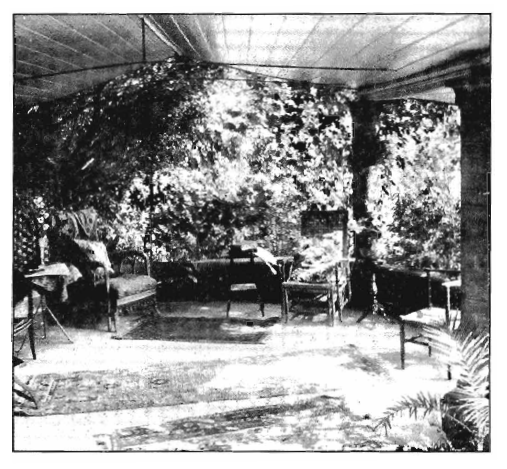
Build a place outdoors which has so much enclosure round it, that it takes on the feeling of a room, even though it is open to the sky. To do this, define it at the corners with columns, perhaps roof it partially with a trellis or a sliding canvas roof, and create “walls” around it, with fences, sitting walls, screens, hedges, or the exterior walls of the building itself.
 sadhana.farm