This is a summary of the 168th pattern from the “A Patter Language” book by Christopher Alexander and his team.
A house feels isolated from the nature around it, unless it’s floors are interleaved directly with the earth that is around the house.
Look first at this house where there is no continuity.
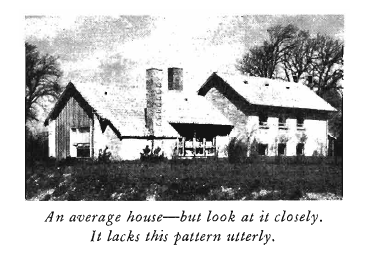
The inside and the outside are abruptly separate. There is no way of being partly inside, yet still connected to the outside; there is no way in which the inside of the house allows you, in your bare feet, to step out and feel the dew collecting or pick blossoms off a climbing plant because there is no surface near the house on which you can go out and yet still be the person that you are inside.
Compare it with this house, where there is continuity. Here, there is an intermediate area, whose surface is connected to the inside of the house – and yet it is in plain outdoors.
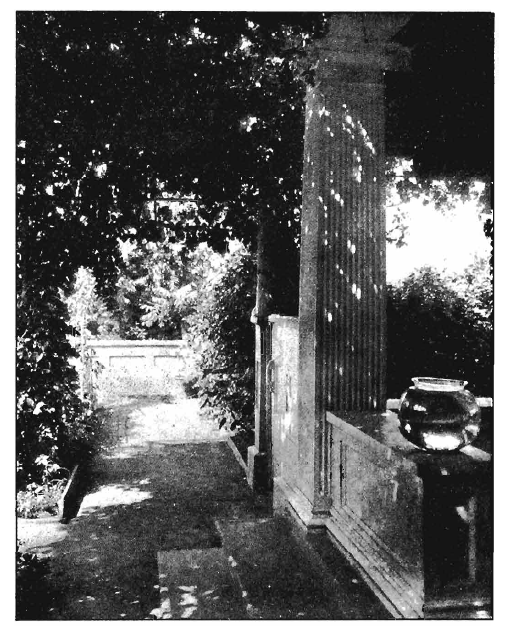
This surface is part of the earth – and yet a little smoother, a little more beaten, more swept – stepping out on it is not like stepping out into a field in your bare feet – it is as if the earth itself becomes in that small area a part of your indoor terrain.
Explanation? Perhaps, our lives become satisfactory to the extent that we are rooted, “down to earth,” in touch with common sense about everyday things – not flying high in the sky of concepts and fantasies. The path toward this rootedness is personal and slow – but it may just be true that it is helped or hindered by the extent to which our physical world is itself rooted and connected to the earth.
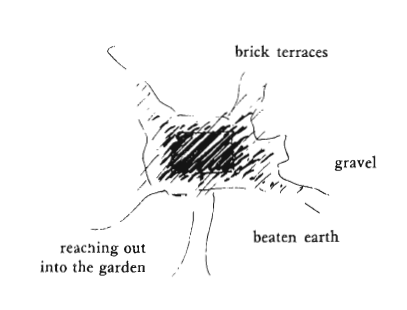
In physical terms, the rootedness occurs in buildings when the building is surrounded, along at least a part of its perimeter, by terraces, paths, steps, gravel, and earthen surfaces, which bring the floors outside, into the land. These surfaces are made of intermediate materials more natural than the floors inside the house—and more man-made than earth and clay and grass. Brick terraces, tiles, and beaten earth tied into the foundations of the house all help make this connection; and, if possible, each house should have a reasonable amount of them, pushing out into the land around the house and opening up the outdoors to the inside.
Connect the building to the earth around it by building a series of paths and terraces and steps around the edge. Place them deliberately to make the boundary ambiguous—so that it is impossible to say exactly where the building stops and earth begins.
 sadhana.farm