This is a summary of the 139th pattern from the “A Patter Language” book by Christopher Alexander and his team.
The isolated kitchen, separate from the family and considered as an efficient but unpleasant factory for food is a hangover from the days of servants; and from the more recent days when women willingly took over the servants’ role.
In traditional societies, where there were no servants and the members of a family took care of their own food, the isolated kitchen was virtually unknown. Even when cooking was entirely in the hands of women, as it very often was, the work of cooking was still thought of as a primal, communal function; and the “hearth,” the place where food was made and eaten, was the heart of family life.
As soon as servants took over the function of cooking, in the palaces and manor houses of the rich, the kitchens naturally got separated from the dining halls. Then, in the middle class housing of the nineteenth century, where the use of servants became rather widespread, the pattern of the isolated kitchen also spread, and became an accepted part of any house. But when the servants disappeared, the kitchen was still left separate, because it was thought “genteel” and “nice” to eat in dining rooms away from any sight or smell of food. The isolated kitchen was still associated with those houses of the rich, where dining rooms like this were taken for granted.
But this separation, in a family, has put the woman in a very difficult position. Indeed, it may not be too much to say that it has helped to generate those circumstances which have made the woman’s position in mid-twentieth century society unworkable and unacceptable. Very simply, the woman who accepted responsibility for making food agreed to isolate herself in the “kitchen”—and subtly then agreed to become a servant.
Modern American houses, with the so-called open plan, have gone some way toward resolving this conflict. They very often have a kitchen that is half-separated from the family room: not isolated, and not entirely in the family room. This does create a circumstance where the people who are cooking are in touch with the rest of the family, while they are working. And it does not have the obvious stigma and unpleasantness of separated sculleries and kitchens.
But it does not go far enough. If we look beneath the surface, there is in this kind of plan still the hidden supposition that cooking is a chore and that eating is a pleasure. So long as this mentality rules over the arrangement of the house, the conflict which existed in the isolated kitchen is still present. The difficulties which surround the situation will only disappear, finally, when all the members of the family are able to accept, fully, the fact that taking care of themselves by cooking is as much a part of life as taking care of themselves by eating. This will only happen when the communal hearth is once more gathered round the big kitchen table, as it is in primitive communities, where the taking care of necessary functions is an everyday part of life, and has not been lost to people’s consciousness through the misleading function of the servant.
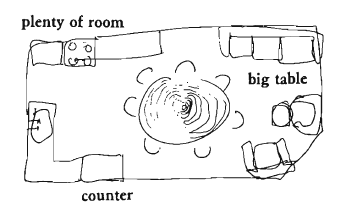
We are convinced that the solution lies in the pattern of the old farmhouse kitchen. In the farmhouse kitchen, kitchen work and family activity were completely integrated in one big room. The family activity centered around a big table in the middle: here they ate, talked, played cards, and did work of all kinds including sonic of the food preparation. The kitchen work was done communally both on the table, and on counters round the walls. And there might have been a comfortable old chair in the corner where someone could sleep through the activities.
Make the kitchen bigger than usual, big enough to include the “family room” space, and place it near the center of the commons, not so far back in the house as an ordinary kitchen. Make it large enough to hold a good big table and chairs, some soft and some hard, with counters and stove and sink around the edge of the room; and make it a bright and comfortable room.
 sadhana.farm