This is a summary of the 106th pattern from the “A Patter Language” book by Christopher Alexander and his team.
Outdoor spaces which are merely “left over” between buildings will, in general, not be used.
There are two fundamentally different kinds of outdoor space: negative space and positive space. Outdoor space is negative when it is shapeless, the residue left behind when buildings – which are generally viewed as positive – are placed on the land. An outdoor space is positive when it has a distinct and definite shape, as definite as the shape of a room, and when it’s shape is as important as the shapes of buildings which surround it.

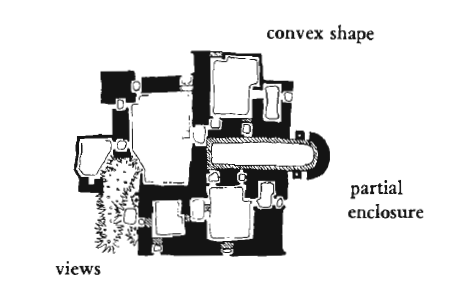
Another way of defining these spaces is by their degree of enclosure and convexity. In Mathematics, a space is convex when a line joining any two points inside the space itself lies totally inside the space.

The L-shaped space is not convex or positive, because the line joining its two end points cuts across the corner and therefore, goes outside the space.

People feel comfortable in spaces which are “positive” and use these spaces; people feel relatively uncomfortable in spaces which are “negative” and such spaces tend to remain unused.
Therefore,
Make all the outdoor spaces which surround and lie between your buildings positive. Give each one some degree of enclosure; surround each space with wings of buildings, trees, hedges, fences, arcades, and trellised walks, until it becomes an entity with a positive quality and does not spill out indefinitely around corners.
 sadhana.farm